

WHAT IS PASSIVATION?
More Than Cleaning — It's Chemical Transformation
Passivation is not a cleaning process — it's a controlled chemical treatment that maximizes the corrosion resistance of stainless steel components.
The Science: Stainless steel contains chromium, which naturally reacts with oxygen to form a thin protective oxide layer. However, machining processes contaminate this layer with free iron particles that cause corrosion.
Passivation removes free iron and accelerates the formation of a uniform, dense chromium oxide barrier (Cr₂O₃) that provides maximum corrosion protection.
The Result: Enhanced corrosion resistance, improved biocompatibility, and surfaces that meet FDA, AS9100D, and ISO 13485 requirements.
At Atomic Machine, passivation is available as a standalone treatment or fully integrated with our in-house CNC machining and laser marking — one vendor, one quality system, one certificate package.
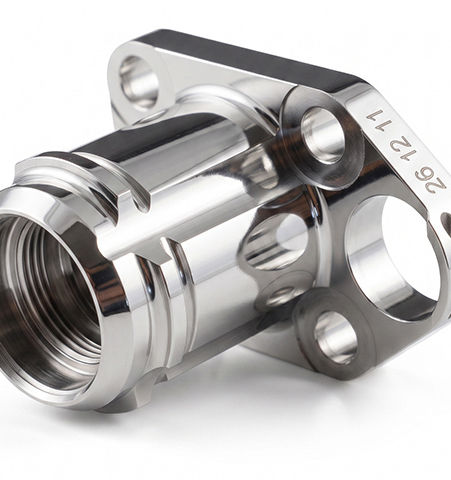
WHY PASSIVATE?
Critical Protection for Critical Components
INDUSTRIES WE SERVE
MEDICAL DEVICES
Surgical instruments, implants, trays, containers, and reusable devices. Passivation provides biocompatible surfaces that resist body fluids, cleaning chemicals, and repeated sterilization.
AEROSPACE & DEFENSE
Aircraft fittings, fasteners, hydraulic components, fuel system parts. Passivation performed per AMS 2700 guidelines ensures corrosion resistance in extreme environments.
INDUSTRIAL & COMMERCIAL
Cylinders, valves, manifolds, and precision fittings for automotive, oil & gas, power generation, and robotics applications. Passivation prevents corrosion and extends service life in demanding industrial environments.
OUR PASSIVATION PROCESS
ASTM A967 & AMS 2700 Process
Step 1: Pre-Cleaning Remove oils, greases, and machining residues that interfere with passivation.
Step 2: Passivation Treatment Immersion in citric acid or nitric acid solution (per ASTM A967) to remove free iron and promote oxide formation.
Step 3: Rinsing & Neutralization Complete removal of passivation chemistry with deionized water.
Step 4: Verification Testing Water break test, copper sulfate test, or salt spray testing to verify complete passivation.
Step 5: Documentation Certificate of Conformance with process parameters, test results, and material traceability.

TECHNICAL SPECIFICATIONS
Capabilities & Standards
-
Standards: ASTM A967, AMS 2700, AMS-QQ-P-35
-
Methods: Citric acid (preferred for medical), Nitric acid
-
Part Size: Small components to large assemblies
-
Materials: All grades of stainless steel (300 series, 400 series, PH grades, duplex)
-
Volume: Prototype to production quantities
-
Verification: Water break test, copper sulfate test, salt spray (per customer requirements)
INTEGRATED SERVICES
Complete Manufacturing Solutions
Passivation works best when integrated with your complete manufacturing workflow:
Machine → Mark → Passivate
-
CNC machine your stainless steel components
-
Laser mark for permanent traceability
-
Passivate for maximum corrosion protection
Single facility. Single quality system. Faster delivery.
COMPLETE MANUFACTURING SERVICES
Combine passivation with our other in-house services.


FAQ
Common Passivation Questions
Q: What is passivation?
A: Passivation is a chemical treatment — not a coating — that removes free iron and other surface contaminants from stainless steel. Removing that contamination allows a uniform chromium oxide layer to form on the surface, which is what gives stainless steel its corrosion resistance. Passivation accelerates and strengthens that layer beyond what forms naturally after machining.
Q: Is passivation the same as cleaning?
A: No. Cleaning removes surface contamination. Passivation is a chemical treatment that removes free iron and creates a protective oxide layer.
Q: How do I know if my parts need passivation?
A: If your stainless steel components will be exposed to corrosive environments, body fluids, chemicals, or require FDA/aerospace compliance — passivation is essential.
Q: Does passivation change part dimensions?
A: No. Passivation is a chemical surface treatment that does not remove measurable material or affect dimensions.
Q: Can you passivate laser-marked parts?
A: Yes. Passivation is safe for laser-marked components and does not damage marks.
Q: What's the turnaround time?
A: Turn around varies by order volume and specification. Contact us for a timeline.
Q: What's the difference between passivation and electropolishing?
A: Both processes improve corrosion resistance, but they work differently. Passivation is a chemical process that removes surface contaminants without changing the part's dimensions or finish. Electropolishing is an electrochemical process that removes a microscopic layer of the base material itself, producing a smoother, brighter surface in addition to improved corrosion resistance. Atomic Machine performs both in-house, so the right process depends on whether a part needs a functional treatment only, or a functional treatment plus a polished finish.
Q: Does passivation remove rust or repair corroded parts?
A: No. Passivation prevents corrosion on a clean surface — it doesn't reverse damage that has already occurred. Parts with existing rust, pitting, or heavy scale need to be cleaned or pickled first; passivation alone won't restore them.
Q: What's the difference between ASTM A967 and AMS 2700?
A: ASTM A967 is the general industry standard for chemical passivation of stainless steel, covering acceptable methods and testing procedures. AMS 2700 is the aerospace-specific specification, with tighter process controls and more extensive documentation requirements. Atomic Machine passivates to both standards depending on the application.
Q: How is passivation verified?
A: Passivated parts are tested using methods like the water break test, copper sulfate test, and salt spray testing, depending on the part and the customer's requirements. Every passivated batch is documented with a Certificate of Conformance covering process parameters, test results, and material traceability.
Q: Is passivation required after CNC machining?
A: Yes, in most cases. Machining embeds free iron particles into the surface of stainless steel parts, which can compromise corrosion resistance if left untreated. Because Atomic Machine performs CNC machining, laser marking, and passivation in-house, parts can move from machining straight into passivation without leaving the facility — reducing handling risk and lead time.
Q: How long does passivation last?
A: In clean, controlled environments, the passive layer can remain stable for years. In harsher conditions — high humidity, chlorides, or aggressive chemical exposure — the layer can degrade faster, and periodic re-passivation may be needed to maintain performance.